IFFI Goa

International Film Festival of India, the premier film event scheduled for November 23-December 3, 2011 will partner the ministry of tourism’s initiative Incredible India.

The 42nd edition, organized jointly by the ministry of information and broadcasting and the Goa government, will work with a diversified focus of merging films with destination marketing, for tourism promotion.

Official sources stated that the 42nd edition has been conceived with a paradigm shift in the philosophy, approach and conduct of the festival with an aim to enhance the image of the event at the global level.

The revamp of the awards was initiated after an active involvement of Union I&B minister Ambika Soni. Sources stated that the minister had desired that the awards need to be reinvented and needed to be profiled higher to be recognized as one of the best film festivals of the world comparable to the Cannes Film Festival and the Berlin Film Festival.

The festival, from 2011, also aims for a large-scale public participation, to ensure inclusiveness and local flavor.

The 11-day film fiesta will have film makers from across the world, presenting their films at the festival. The festival will screen a range of films from around the world — various international award winners, film festival favorites, critics choices and box office hits in its International Competition and Cinema of the World Sections.

These films will have its India Premiere at IFFI, and most of them are likely to be attended by the respective directors, cast and crew. It will also host a number of specially curated sections like the “European discoveries”, “Made in Poland” with a spotlight on the contemporary film making trends in Poland, Retrospectives on the French Doyen Luc Besson and the Australian Helmer Philip Noyce. The festival will also pay “homage” to film luminaries who passed away in 2010, including Raul Ruiz, Adolfas Meekas, Sidney Lumet, Claude Chabrol and Elizabeth Taylor.

 
Orissa Goa Tourism

Odisha and Goa have jointly decided to promote tourism in the two states on mutually beneficial terms. The two states have signed a MoU to increase tourist inflow to both states.

“This will be a win-win situation for both the states. The MoU will help mutual promotion of tourism, showcasing each other’s cultural heritage to tourists and facilitating inbound travel into the respective states,” said Manoranjan Patnaik, Managing Director, OTDC.

Officials said the annual tourist inflow to Odisha is around 60 lakhs while the inflow in Goa is much more. “A sizable number of tourists are coming from Goa to Odisha, and vice versa, but most of such tourists are booking through online portals or other private channels. As a result, the state governments are losing revenue. Through this tie up, both the state agencies would facilitate the tourist inflow to both states and also promote different packages,” Patnaik added.

Officials from the tourism department said that according to the MoU, the states would mutually market their accommodations and tourism packages. Sources said that next in line are Kerala, Maharashtra, Andhra Pradesh and Karnataka where Odisha intends to promote Wildlife Tourism, Religious Tourism, Beach Tourism and Heritage Tourism.

“Odisha is targeting more foreign tourists through this tie up. People of Odisha are mostly interested in the lively sea beaches, monuments and night life in Goa, while we have planned to promote our Buddhist circle, temple architecture, Tribal Tourism, the golden triangle and so on,” Patnaik added.


Cyclone Phyan has made topographical alterations on some of the Goa’s beaches and the tourism department may consider a re-survey of affected beach Goa Baechesstretches if asked for by shack applicants.

“Sand dunes have disappeared from some of the beaches in South Goa,” says Cruz Cardozo, president, Shack Owners Welfare Society (SOWS).

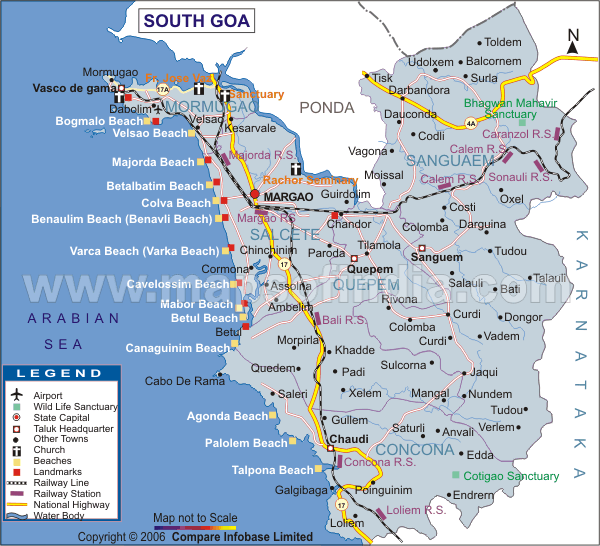
“Some of the beaches which have lost sand dunes are Colva, Benaulim, Betalbatim and Majorda,” he added.

Cardozo said that he would have to take into consideration petitions from his members affected by the topographical alterations on their beach stretches. Continue reading »


Goa is the most vulnerable among coastal area, as major portion of its beaches would be submerged within a foreseeable future due to climatic changes, water-sportaccording to a scientific study.

‘Environmental Education and Sustainable Development in the New Millennium’, a book released by Dr Desh Bandhu, president, Indian Environment Society on the occasion of “VIII Global Conference on Environmental Education 2009” says that Goa being a State with shortest coastline, is more prone to sea level rise due to global warming and climatic change.

Around 4.3 per cent of Goa’s a 105-km coastline has already been affected by one meter rise in sea level, an article in the book on ‘Global Warming and Climatic Change’ claims.

The article also reads that till date 7.3 per cent of Goa’s coastal population is affected by beach erosion which is also very high compared to other States.

“By 2050 and 2080 if the sea level would rise by 38 and 59 meters respectively, then Goa would lose maximum percentage of its land and its population,” the article reads.

The article further says that Goa being dependent much more directly on climate can be hit much harder and sudden by large climatic change.

According to data presented in the state legislative assembly during the recent monsoon session, more than 10 per cent of the State’s beaches have already been eroded due to global warming and the consequent rise in sea water levels.

The state tourist authority has expressed concern and said it is working with scientists to shore up beaches so that they are not lost to the Arabian Sea.

Goa based environmental scientists have said the destruction of mangroves and salt pans, plus sand mining and construction for tourism have exacerbated the problems.

The article also says that other then Goa, West Bengal is a State where beach erosion has affected to a large extent.

“Of its total 8.3 million hectares coastal area nearly 1.4 per cent is affected thus harming 2.3 per cent of its population,” article says.

However, Maharashtra with highest coastal area of 30.8 million hectares, only 0.13 per cent of its area is under beach erosion harming 1.7 per cent of its population.

It also states that Karnataka and Andhra Pradesh are the least affected states where 0.6 and 0.9 per cent of its coastal area people were affected by rise in sea level.

As per the article on an average 0.4 per cent of India’s coastal area was affected by the rise of one meter sea level which affected 1.7 per cent of its total coastal population.


Goa state cabinet has approved the beach shack policy for the 2009-10 season and said that shack allotment will be made on seniority basis. In goa-map2008, the tourism department had issued application forms in September while this year the forms were issued only on Tuesday.

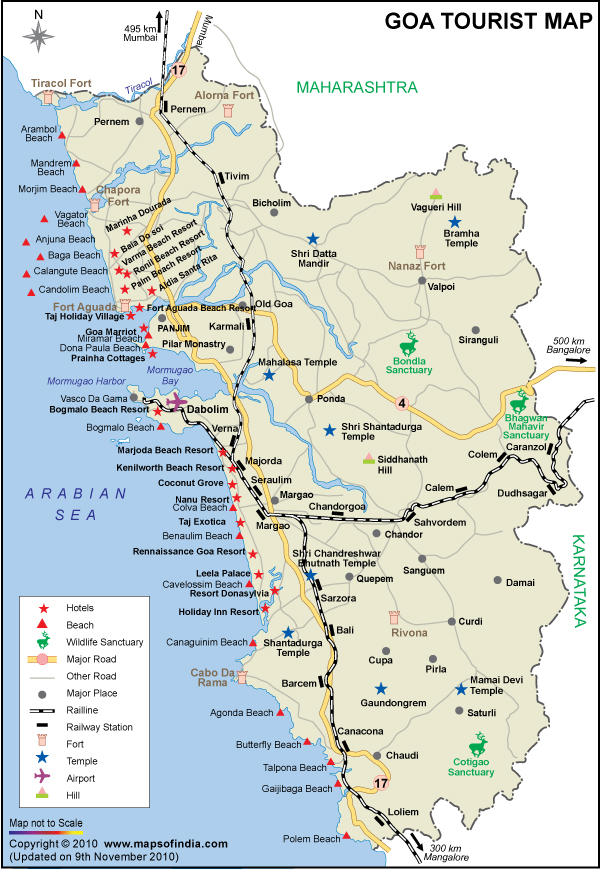
According to the policy, 240 shacks will be permitted in the north coastal belt while 106 shacks will be allowed in the south.

The tourism department has specified that wherever the number of eligible applicants is more than the number of shacks permitted on any particular beach, the selection will be made by way of lots. The shack policy also specifies that 90% of the shacks will be allotted to applicants having past experience, while the remaining 10% will be allotted to new applicants, who have no experience, by draw of lots.

The run-up to the current tourist season also saw a stand-off between two rival shack associations  the older Shack Owners Welfare Society (SOWS), and the new Traditional Goan Shack Owners Association (TGTSOA) and the row may threaten to derail the shack allotment process.

“If we were to look over the whole world to find out the country most richly endowed with all the wealth, power and beauty which nature can bestow- in some parts a veritable paradise on Earth- I should point to India. If I were asked under what sky the human mind has most fully developed some of its choices gifts- I should point to India.”

- Max Muller
© 2012 Coastal Tourism India Suffusion theme by Sayontan Sinha